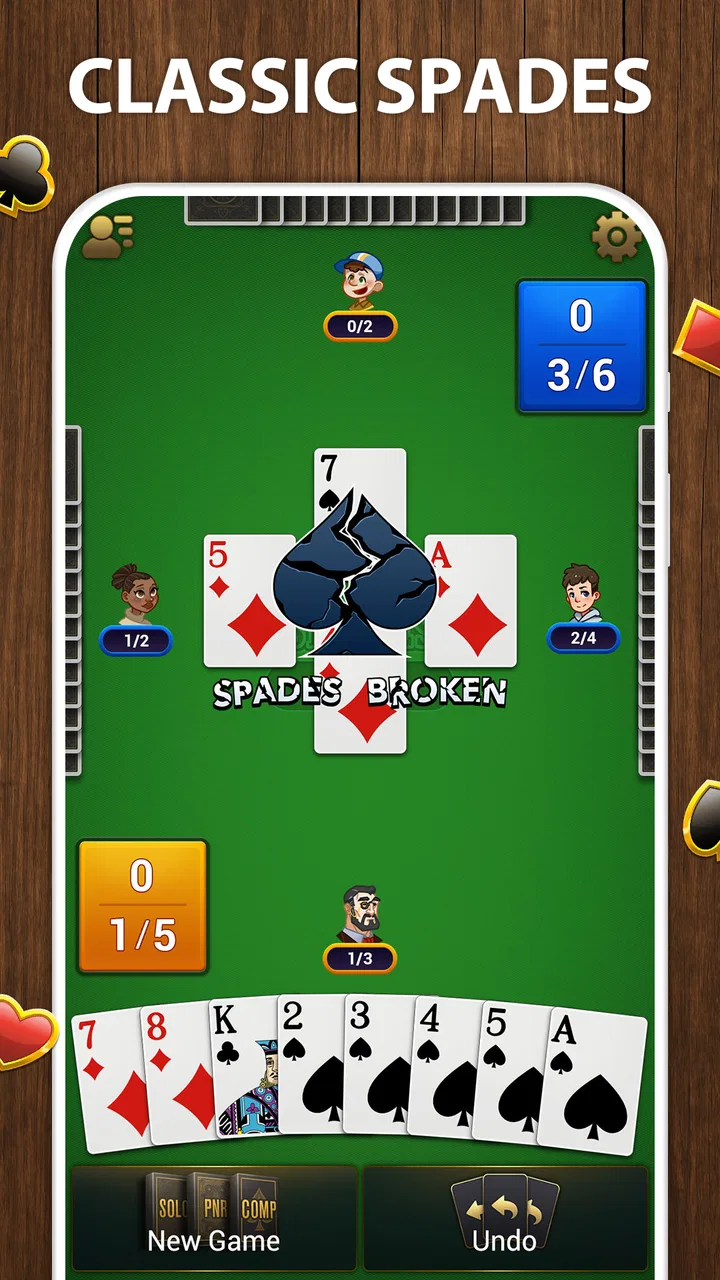
Spades Solitaire - Card Games
- 4.9
- Rating
- 10.00M
- Installs
- Free
- Price

 Analysis by App-foxy
I spent time with Spades Solitaire as a quiet, pick-up-and-play card game, and its appeal became clear quickly: it turns a familiar trick-taking format into something that fits neatly into short breaks. I can start a hand without preparing a group of players, learn the rhythm after a few rounds, and stop when I need to return to whatever I was doing. That makes it a very different experience from a competitive card table or a long strategy game.
This is a free card game from Topy Games for Android devices, aimed at Everyone. It has been available since November 23, 2021, and the current version is 1.27.4.20260203. The game has passed over ten million installs, with an average rating of 4.9 from roughly one hundred fourteen thousand ratings. Those figures suggest a large and generally satisfied audience, although popularity alone does not tell me whether a game suits a particular player. In my experience, the real question is whether you want relaxed solitaire convenience or a deeper, more demanding card simulation.
How the current version feels in everyday play
I find the current release easiest to judge through ordinary use: opening a hand during a short break, making a few deliberate choices, and putting the game aside when time is up. That simple rhythm is the real test of whether the interface supports quick, low-pressure play rather than demanding a long session. It also gives useful context for considering what ongoing releases mean to someone who returns regularly.
You May Also Like

 Pandora - Music & Podcasts
Pandora’s Music Is Easy to Start, but Harder to Recover
Pandora’s strength is its low-effort path from a seed to a station. Its weak spot is how much confidence it asks you to place in connection, setup, and quiet recovery.

 8 Ball Pool
 Is Built on Rivalries, Rematches, and Routine
A close look at the rivalries, rematches, shared routines, and unanswered safety questions that turn a quick pool match into a persistent mobile community.

 Samsung Music
’s Quiet Strength Is Playing What You Already Own
Its reach comes less from spectacle than from dependable access to a personal library. That simplicity is both the app’s strongest retention engine and its ceiling.

 AccuWeather: Weather Radar
AccuWeather Review: A Quick, Clear Forecast for Everyday Decisions
For everyday plans, the best forecast is the one you can understand quickly. AccuWeather makes rain timing, radar, and local conditions easy to act on, with a few trade-offs.

 Hill Climb Racing
Why Hill Climb Racing Still Turns Crashes Into One More Run
A tiny car, a bumpy hill and one more upgrade: Hill Climb Racing keeps resurfacing because its simple chaos makes every near-miss feel personal.

 AliExpress - Shopping App
AliExpress Makes Global Shopping Feel Personal, but Shoppers Bear the Risk
AliExpress turns a global marketplace into a pocket-sized discovery engine. Its reach is useful, its shopping loop compelling, and its trade-offs easy to miss.
More From Our News Desk
View All News


A familiar card game made for short sessions
The central attraction is the combination of Spades strategy and solitaire-style solo play. Instead of waiting for opponents or arranging a physical deck, I can go straight into a hand and focus on reading the cards, estimating tricks, and deciding when to spend valuable spades. That structure works especially well when I have only a few minutes, such as while waiting for an appointment or winding down before bed.
I also like that the game does not require a large commitment from the player. A traditional card session can become a social event, while this format is more private and flexible. I can play attentively when I want to think through every move, or use it as a light mental reset when I do not want a demanding action game. The best use case is not a marathon session; it is the small gap in the day where a complete game would normally be inconvenient.
The solitaire framing changes the emotional tone of Spades. Against human players, a poor decision can feel like a direct loss to someone else. Here, the pressure is more personal: I am testing whether I can manage the hand cleanly. That makes mistakes easier to accept, but it can also make repeated attempts feel less exciting for players who need conversation, bluffing, or unpredictable opponents.
What I pay attention to during a hand
New players often think Spades is mainly about winning as many tricks as possible. In practice, I find the more useful question is what each trick costs me later. A high card may secure an early win but remove an important answer for a later suit. Spades are powerful because they can cut another suit, yet using one too soon may leave the rest of the hand awkward. The solitaire format gives me room to notice these patterns without the distraction of a live table.
My most reliable approach is to pause before playing a strong card and count the likely consequences. I look for suits that may become dangerous after they are exhausted, then consider whether a spade should be saved for that moment. I also avoid treating every available trick as automatically beneficial. Sometimes the better move is to let another card take the trick so that my stronger cards remain available for a more important sequence.
That kind of planning is one of the game’s less obvious strengths. It can be relaxing, but it is not mindless. The experience rewards patience and memory more than fast reactions. If you enjoy logic puzzles, turn-based tactics, or classic card games, you may find more depth here than the simple presentation initially suggests.
Why the free format is convenient
Being free makes the game easy to try without turning the decision into a purchase. I can install it for a particular situation, such as a trip or an evening without internet entertainment, and decide from actual play rather than from screenshots. The Everyone age rating also makes it a straightforward choice for households looking for a mild card game rather than something built around mature themes.
That convenience comes with a trade-off common to free mobile games: the experience may not feel as focused as a paid, minimalist card app. Players who are sensitive to interruptions, visual clutter, or any friction around the main play area should approach it with realistic expectations. I would choose a dedicated paid solitaire product when my priority is a completely quiet interface and nothing else competing for attention.
Who will get the most from it
I would recommend this game to someone who already enjoys classic card rules but wants a solo option. It is also a good fit for people who like games that can be played in short bursts without reflex controls, complicated tutorials, or a large social commitment. The strategic layer is enough to keep a familiar format interesting, especially when I deliberately try to improve my decisions rather than simply rush through hands.
It is less suitable for anyone looking for real-time multiplayer, a strong narrative, or a constantly changing progression system. A player who wants dramatic competition may prefer an online card table, while someone who wants pure Klondike-style sorting may find Spades’ trick-taking decisions less immediately intuitive. The distinction matters: this is not just another automatic card-clearing game, and it is not a substitute for playing Spades with friends.
What the release history means for players
A version history matters most when it helps a familiar game remain usable, not when a number alone suggests dramatic change. I would treat the current release as a reason to check that the game still feels comfortable on my device, then settle back into the same measured approach to managing suits and spades. That leads naturally to the practical question of which parts of the experience still create friction.
The current version and signs of continued maintenance
The version currently listed is 1.27.4.20260203, which indicates that the game has continued receiving version updates since its original release on November 23, 2021. I see that as useful context for existing users. A card game can remain playable for years without major changes, but ongoing version work generally matters for keeping an older mobile title compatible with current devices and maintaining a usable experience.
I would not interpret a newer version number as proof that the core rules have been transformed. The safest expectation is continuity: the same basic solo Spades idea remains the reason to install it, while updates help the product stay current. That distinction is important for returning players. If you enjoyed the earlier version, the current release should be approached as an updated home for the same kind of card session, not as a completely different game.
The large install base and strong average rating also explain why the game has staying power. They show that the format works for many people, but they do not remove the need to test its particular feel on your device. Card games are unusually sensitive to small interface choices. A player who loves one layout may dislike another, so I would judge the handling of cards, readability, and interruption level during several hands rather than deciding after the first screen.
How updates affect someone who already plays
For an existing player, the most practical benefit of staying current is preserving access to a maintained version rather than relying on an old installation. I would update before a trip or before setting the game aside for a long period, then open it once to make sure the controls and saved routine still feel familiar. This is a simple habit, but it avoids discovering an unexpected change when I am depending on the game for offline downtime.
Returning players should also give themselves a short adjustment period. Even a small interface refinement can alter where I look before making a move. I find it helpful to play a low-pressure hand first, concentrating on card recognition instead of trying to beat a personal target immediately. That approach separates a change in presentation from a change in strategy and makes it easier to decide whether the current version still suits me.
There is another effect of a maintained release: it can make the game a more dependable recommendation for relatives or friends using different Android devices. The minimum operating system is Android 6.0, so the compatibility range includes older hardware as well as newer phones. I would still check the target device in practice, particularly if its screen is small or performance is limited, because a technically compatible game may not feel equally comfortable everywhere.
Small habits that improve the experience
I recommend treating each hand as a planning exercise rather than tapping through obvious cards. Before committing a spade, I ask whether it is solving a real problem or merely winning a trick that could have been won later. I also try to remember which suits have already been weakened. This reduces the common mistake of spending the strongest resource early and then having no answer when the hand becomes constrained.
Another useful routine is to separate learning from scoring. During the first few hands, I focus on identifying the game’s rhythm and how much information remains visible. Once that becomes comfortable, I set a small personal goal: preserve more options, avoid premature spades, or finish a hand with fewer questionable choices. This gives the solo format a sense of progression without pretending that it offers the same motivation as a campaign or a ranked multiplayer ladder.
For a daily scenario, I might play one hand during a coffee break, stop immediately afterward, and return later without needing to remember a story or a large quest chain. In the evening, I can instead play more carefully and use the game as a concentration exercise. That flexibility is more valuable to me than a flashy feature list because it matches the way mobile games are often actually used: in uneven pieces of spare time.
Where it still falls short
For me, the main drawback is not a single missed feature but the narrowness that comes with repeating solo hands: the strategy can be satisfying, yet it cannot recreate the unpredictability or social reading of a live table. I would keep that distinction in mind before making it my regular card game, especially if variety is what keeps me engaged. The remaining limits become clearer when I compare it with the kinds of players who will want something else.
The limits of solo card play
The biggest limitation is built into the format. Playing alone removes the social reading that makes table-based Spades special. I cannot surprise a human partner, interpret a rival’s hesitation, or enjoy the conversation around a close hand. The game can still make me think, but the challenge is self-contained. After several sessions, players who rely on social competition may feel that the experience has become predictable.
There is also a ceiling to the variety of a single card concept. The strategic decisions can remain engaging, yet the basic activity is still repeated hands. I would not choose it as my only mobile game if I need constant novelty. It works better as a dependable side game: something I return to when I want a familiar mental pattern, not something expected to provide a new world every time I open it.
Who should choose another option
I would steer competitive players toward a multiplayer Spades app instead, provided they value live opponents and social interaction more than convenience. Someone who wants a pure, distraction-free solitaire board may be happier with a paid alternative that concentrates on one classic layout. And if you prefer fast action, this game’s deliberate, turn-based pace may feel slow no matter how polished the card handling is.
Players with very specific preferences should also be selective. If you need extensive customization, unusual rule variations, or a deep progression system, I would investigate those requirements before settling in. The strength here is accessibility and repeatable solo play, not the promise of an enormous rules laboratory. Choosing it for the right reason prevents disappointment: it is a practical card companion, not a replacement for every type of card experience.
What I would watch in future versions
For future updates, I would pay attention to whether the developer continues improving clarity without making the core play feel busier. Readable cards, dependable touch response, and a smooth return to a hand matter more to me than decorative additions. I would also watch how well the game remains comfortable on older Android hardware, since its stated minimum of Android 6.0 makes broad device accessibility part of its identity.
I would be interested in any changes that deepen decision-making without turning short sessions into a complicated commitment. Better explanations for newcomers could help people who understand solitaire but not trick-taking strategy. At the same time, experienced players need the option to move quickly once they know the rules. The ideal direction would preserve that balance: approachable at the start, but respectful of players who want to think independently.
My recommendation after playing
After using it as a regular short-session card game, I see Spades Solitaire as a strong choice for relaxed solo strategy. Its free price, Everyone rating, broad Android compatibility, and large audience make it easy to try, while the decisions around timing and suit management give it more substance than a purely automatic solitaire title. I especially value it when I want something quiet that still asks me to pay attention.
My recommendation is conditional rather than universal. Choose it if you want a familiar card format that works around your schedule and you are comfortable with a solo experience. Skip it if the main reason you play Spades is the human table, lively competition, or extensive variety. For the right player, Topy Games has made a dependable pocket card game that is simple to enter but rewarding enough to revisit. The best way to enjoy it is to play slowly, save your strongest cards for the moments that truly need them, and judge it as a calm daily companion rather than a full-scale competitive platform.
FAQs for Spades Solitaire - Card Games
01What is Spades Solitaire - Card Games?
Spades Solitaire - Card Games is a mobile app that combines the classic games of Spades and Solitaire. It offers a unique twist on traditional card games by merging elements from both, providing a fresh and engaging experience for card game enthusiasts. It's available for both Android and iOS platforms.
02Is Spades Solitaire - Card Games free to play?
Yes, Spades Solitaire - Card Games is free to download and play. However, it may contain in-app purchases and ads that can enhance the gaming experience or unlock additional features. Always check the app store for specific details regarding pricing and available purchases.
03What features does Spades Solitaire - Card Games offer?
The app features multiple game modes, daily challenges, and customizable card decks. It also includes leaderboards and achievements to track progress and compete with friends. The user-friendly interface and smooth gameplay make it accessible for both beginners and experienced players.
04Can I play Spades Solitaire - Card Games offline?
Yes, Spades Solitaire - Card Games can be played offline, allowing users to enjoy the game without an internet connection. However, certain features like leaderboards and daily challenges may require an internet connection to function properly.
05Are there any age restrictions for Spades Solitaire - Card Games?
The game is generally suitable for all ages, but it is recommended for players aged 12 and above due to strategic elements and competitive gameplay. Parents should review the app's content and features to ensure it aligns with their expectations for younger players.
Pros
- Smooth and intuitive user interface.
- Variety of game modes available.
- Offline play is supported.
- Regular updates with new features.
- Minimal ads for a free app.
Cons
- Limited customization options.
- Occasional connectivity issues.
- In-app purchases can be pricey.
- Some modes require internet.
- No multiplayer chat feature.

Spades Solitaire - Card Games
Gallery